Saturday, January 6, 2018

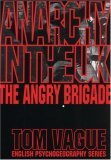
Review: Anarchy In The Uk: The Angry Brigade

Anarchy In The Uk: The Angry Brigade Anarchy In The Uk: The Angry Brigade by Tom Vague
My rating: 3 of 5 stars

I have thought about reading this book for a while because I have always thought the history of urban guerrillas was fascinating. Over time my views on the subject have changed and become more complex. Reading this book has even further contributed to that and especially in relation to this group.

This book has only further confirmed to me that situationism is stupid, vanguardist, and has contributed to the atmosphere of performance politics over substance that we have now in the left. The angry brigade is case in point. With a pre-punk chic, this group bombs symbols of power and destroyed a number of building facades to inspire people and draw attention to the role of the state and capital. However they explained their activity in the underground press, lacked any kind of working class avenger effects (in comparison to the Argentine Anarchists of the 1920s and 30s) and were counter culture to such an extreme that they lacked connection to anyone outside of the youth culture.

can attacks on symbols inspire people? when done right and not done with some nihilistic artistic asthetic. Apparently many of the hangers on of the angry brigade also helped form the sex pistols, which the book described as a situationist inspired group.

View all my reviews

Sunday, December 17, 2017

Review: The Poverty of Statism. Anarchism versus Marxism A debate

The Poverty of Statism. Anarchism versus Marxism A debate The Poverty of Statism. Anarchism versus Marxism A debate by Rudolf Rocker
My rating: 4 of 5 stars

This is a damn good read by serious theorists who were also heavily involved revolutionaries of their day. Bukharin was the main theorist of the left wing of the Bolsheviks and Luigi Fabbri was a very important Italian anarchist in influence at the time second only to Malatesta. I think that their critique of the state is totally useful to many anarchists who cannot quite distinguish it from an anarchist organization and as such may be liable to turn reformist or join a government like Garcia Oliver.

Short but Sweet.

View all my reviews

Monday, November 6, 2017

Review: The Lightning Tree

The Lightning Tree The Lightning Tree by Patrick Rothfuss
My rating: 4 of 5 stars

For those in love with the Kingkiller Chronicle, this short story in the life of Bast and his somewhat creepy but also wonderous fae ways. Its pretty much the story of someone who goes out for carrots and in the process causes a fuck ton of mischief. If anything, it made me respect Rothfuss as a writer even more because the character really comes alive and truly has that inhuman quality to him, while being extremely 3 dimensional.

He has a lot of the cleverness of Kvoth, but without much of the common sense. My only sadness is I probably need to wait another 5 years for anything else in this series to be released.

View all my reviews

Tuesday, October 24, 2017

Battle Brothers: Day 1

I got this game because it was 50% on steam and a gritty medieval fantasy strategy game about a mercenary company... so pretty ideal.  And without further ado!!!!!!


.....After barely surviving an ambush where my captain and the rest of the company were slaughtered, the 4 veterans loped into a nearby town to tend to their wounds.  Renaming the company "The Red and the Black" (with our flag depicting a monarch holding his own bloody head), they demanded revenge and set about recruiting four farmers for the task.  These including a miner, the only survivor of a mine accident and armed with a pick ax, a farmer with a long pitchfork, a miller (who was cut down in his first engagement), and a man whose lover was murdered by bandits.

After capturing and torturing to death a member of the outlaws, the Red and the Black caught up to their former foes.  Suffering a bad sword wound that incapacitated but didn't kill the drunk but suicidal axman veteran (this is literally part of his backstory and battle effects), the company slaughtered their foes and took the head of the enemy back to the local village for a reward.


In the next few hours, the company lost its miner (literally the opening enemy salvo took half of his face off), fought zombie warriors over a preserved hand, and recruited more class conscious peasants to the cause.  This game is punishingly hard and I hope that we survive.  Tune in for the next report!

Saturday, September 23, 2017

Review: The Anarchist Expropriators: Buenaventura Durruti and Argentina's Working-Class Robin Hoods

The Anarchist Expropriators: Buenaventura Durruti and Argentina's Working-Class Robin Hoods The Anarchist Expropriators: Buenaventura Durruti and Argentina's Working-Class Robin Hoods by Osvaldo Bayer
My rating: 4 of 5 stars

After reading Patagonia Rebelde by Bayer, I figured I would check this one out too to get a more rounded idea of the development of Argentine Anarchism. While it appears that much of the same activity was happening as in Spain, it seems weaker, more divided, less developed in revolutionary theory than in individualistic propaganda of the deed, and created cycles of attack and counter attack to raise money to get comrades out of jail.

The actual murders of anarchists by other anarchists in debates over expropriation seems rather relevant for today's sectarianism and only furthers my view that we must support our comrades who are attacked by the state, while building up a credible revolutionary infrastructure who can actually revolt. This urban guerrilla activity is a necessary experience which came out of a very repressive situation, but ultimately failed. We need to examine historical periods like this if we can ultimately learn from our mistakes and hope to build a powerful movement that can take on our class enemies.

View all my reviews

Friday, September 15, 2017

Review: The Occupation Of The Factories: Italy 1920

The Occupation Of The Factories: Italy 1920 by Paolo Spriano
My rating: 0 of 5 stars

This book is an interesting read by a Marxist-Leninist of the factory occupations which swept Italy in 1920 and a critique of a social movement's inability to seize the revolutionary moment. While mostly focusing on the Italian Socialist Party and the various strains inside, it includes the various factions in the state and industrialists for an overhead view of why things played out the way they did.

The thesis seems to be that the occupation movement failed because a lack of disciplined leadership in the PSI, the likely fact that it was a dialectical steam valve of the workers movement which would have been slaughtered in the streets (rather than in the defensive positions of the factories), and the idea that they could have gone for broke if they had national action (and were sold out by reformist leadership), but Turin and some of the anarchist strongholds were more advanced than the workers in the rest of the country.

I am actually a novice when it comes to Bordiga, Gramsci and others ...so that was very interesting. That being said it seemed to slight the anarchists who had hundreds of thousands of participants and set the tone in Turin and other places for more confrontational action.

If anything, this book awakened in me a need to read more of this period from different viewpoints and with more of a focus on Gramsci, Luigi Fabbri, Malatesta, and Bordiga.

View all my reviews

Tuesday, September 12, 2017

Review: Ready for Revolution: The CNT Defense Committees in Barcelona, 1933-1938

Ready for Revolution: The CNT Defense Committees in Barcelona, 1933-1938 Ready for Revolution: The CNT Defense Committees in Barcelona, 1933-1938 by Agustín Guillamón
My rating: 4 of 5 stars

There are very few books which really dispel most historical interpretation of an event and movement as much as this book. The level of organization and commitment of basic rank and file militants and their fierce connection to the labor movement and their local community is vital to understand.

According to Garcia Oliver, "The Revolution does not exist to satisfy some aesthetic appetite but to resolve a series of social questions".

This book takes you into the heart of things, from a literal play by play of the worker victory over the army uprising in Barcelona, to meeting minutes of the FAI, defense committees, and plenums discussing questions which few anarchists in the US have even given much thought: should we "go for broke" and seize power from the state and other left wing organizations, should we form an alliance of convenience, what should the defensive structures look like, what kind of autonomy do they have vis a vis the unions, revolutionary ward committees and the necessity of revolutionary committees to coordinate struggle (vs ad hoc involvement), what is the role of "intelligence" and "control patrols" (police), prisons, and others.....

This is not a primer book on the Spanish revolution, but definitely gives one an idea of the lengths in which the anarchist movement needs to actually go in terms of preparedness, depth of organizational capacity, and in terms of needed theoretical advancement. A must read for anyone serious about revolution.

View all my reviews